
Central Florida seed and mulch
Hydroseeding in Orlando, FL
Seed, mulch and tackifier sprayed in one pass on flat, sandy ground, planned around a dry winter and a wet, stormy summer.
- No-charge walk-through of the lot before we quote
- Seed matched to Florida warm-season grasses, not northern blends
- Seed, mulch, prep and erosion items listed on separate quote lines
Grass From Seed on Florida Flatwoods Sand
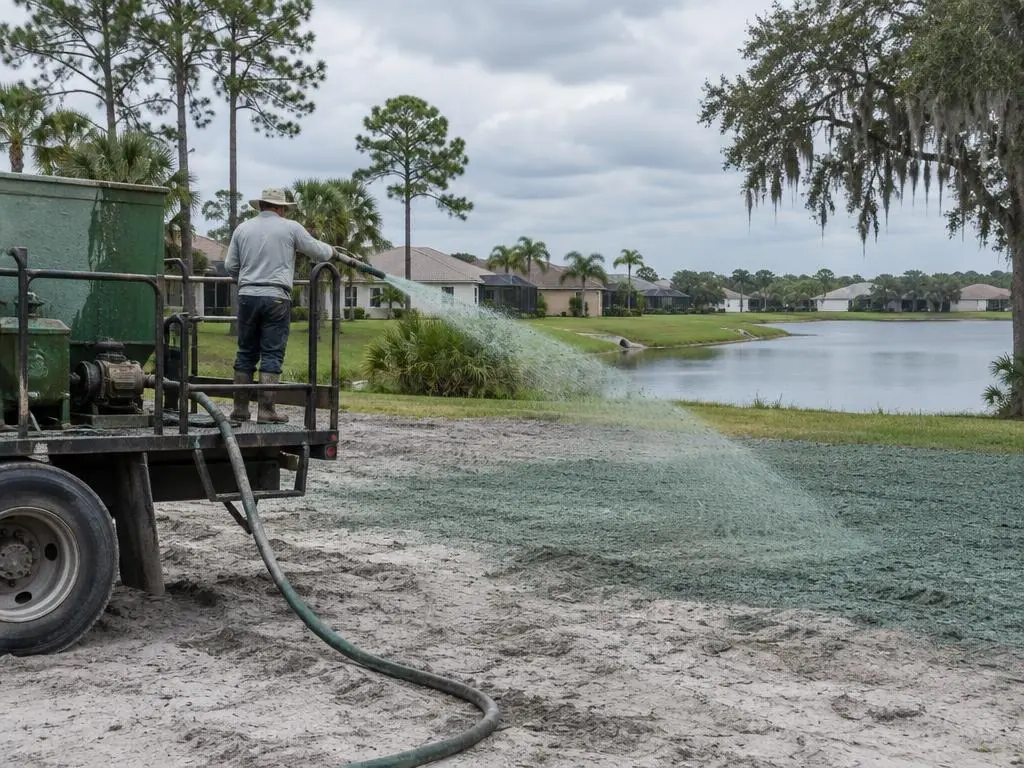
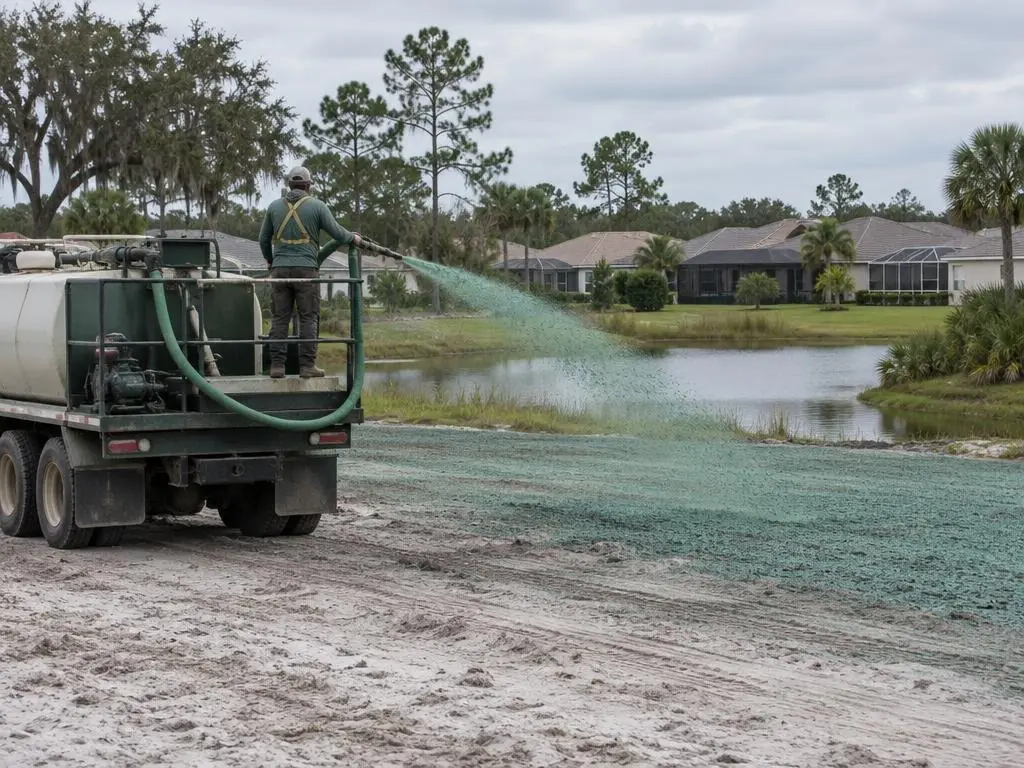
Hydroseeding in Orlando means getting grass to root in flat, sandy, often wet ground under a sky that either pours or barely rains, depending on the month. Elite Hydroseeding Orlando loads seed, wood fiber mulch, fertilizer and tackifier into a tank with water, then sprays the blend across bare soil, so the whole surface is covered and the seed is held down the day we finish. Our hydroseeding services cover new lawn installation, builder lots and commercial pads, pond banks and swales, silt fence and inlet protection, grading and topsoil, and repair of thin lawns across Orange, Seminole, Osceola and Lake counties.
Sand on top, water underneath
Orlando's geography is mostly wetlands: hundreds of lakes and swamps on ground that is generally flat, low and wet. Florida's official state soil, Myakka, shows what that means for a lawn. It forms in flatwoods from old marine deposits, starts with a very dark gray sand surface about 5 to 6 inches thick over gray sand, and is low in organic matter and fertility. Under natural conditions its water table can sit within 10 inches of the surface for 1 to 5 months of the year, then drop below 40 inches in dry periods. So the same yard can be bone dry in April and soggy in August. Seed on that kind of ground needs mulch that holds moisture in the dry months and a grade that moves water off in the wet ones.
The bedrock under Central Florida is porous limestone, and the area is known for sinkholes. If a yard has a new depression or a ring of cracked soil, it should be looked at before anyone fills it with topsoil and seeds over it.
A two-season year
Orlando has a very hot, rainy season from May until late October and a mild, dry season from November through April. Average rainfall is 51.45 inches a year, and most of it falls from June through September. In summer, afternoon thunderstorms come almost daily and can drop several inches of rain per hour, enough to move loose seed and cut channels across a bare lot. In the dry season, the risk flips: the sand dries out fast, and wildfire warnings are common in the later months. Freezes are rare, averaging only 1.6 nights a year, and the city sits in plant hardiness zone 10a, so warm-season grasses are the only sensible choice.
What can be seeded here, and what cannot
St. Augustinegrass is the most common lawn grass in Florida, but it is planted only as sod, plugs or sprigs. Nobody can hydroseed it. The grasses that do grow from seed here are bahiagrass, bermudagrass, centipedegrass and a few zoysiagrass types. UF/IFAS lists seeding rates from 5 to 10 pounds per 1,000 square feet for bahiagrass down to a quarter pound to 1 pound for centipedegrass, which has tiny seed. Bahiagrass is the workhorse on sandy ground: it roots deep, persists in infertile soil, and is a good choice for large lots, acreage and anywhere without irrigation. It does go brown and dormant in long droughts. We also steer people away from bargain seed blends heavy in ryegrass or fescue, which UF notes sprout fast but die quickly in Florida's heat.
Sod, hydroseed or dry seed
Sod gives instant cover and UF recommends it where immediate erosion protection or appearance matters, but it costs the most and has to go down fast; in summer, sod on a pallet lasts less than 48 hours. HomeGuide's range for laid sod is $1 to $4 per square foot, while hydroseeding runs $0.12 to $0.35. Dry seed is the cheapest, but UF's own instructions call for covering 50 to 75 percent of the bare ground with straw or hay so seed is not washed away. Hydro seeding puts the seed and the mulch down together. Extension sources put hydroseeded grass visible in about 5 to 7 days; seed spread dry usually takes two to three weeks to show. The University of Nebraska sums up the cost picture plainly: a little more than dry seeding, generally less than sod.
Picking the month
UF/IFAS says year-round planting is common in most of Florida, but the best time to seed warm-season grass is spring and summer, when it grows fastest. For an Orlando yard, that points to April through early June: warm enough for quick germination, with the heaviest storms still ahead. Summer seeding works too, with a heavier mulch rate, tackifier and drainage fixed first. From November through March seed holds well because rain is light, but growth is slow and the lawn depends on irrigation. UF is direct about it: if irrigation water is not available, avoid planting in the dry months.
Building sites and stormwater
On construction jobs, the Florida Department of Environmental Protection requires Construction Generic Permit coverage once a project clears or grades an acre or more, and smaller projects can be pulled in when they belong to a bigger planned development, as long as the site drains to surface waters or a storm sewer system. That permit calls for a stormwater pollution prevention plan and erosion and sediment controls, and coverage is closed out only after the site reaches final stabilization. That is where hydroseeding contractors earn their keep. On projects permitted through the St. Johns River Water Management District, compliance staff also inspect during construction to check that stormwater is not washing debris into drains, wetlands or lakes. Orlando's checkerboard of city land and unincorporated Orange County means two nearby sites can answer to different local offices, so we confirm that early. We also work alongside other erosion control contractors and site crews when a project splits the scope.
How a job runs
- We walk the site and note low spots, slopes, sun, irrigation and access
- Fine grading and topsoil where the grade or soil needs it
- Silt fence or inlet protection first on permitted sites
- Seed, mulch, fertilizer and tackifier sprayed in one pass
- Blankets on pond banks and steep spots that slurry alone will not hold
- Written watering steps, and a check on germination
Lakes, Ridges and New Subdivisions We Cover
We work in Orlando and the towns around it. North of downtown, Winter Park, Maitland, Altamonte Springs, Casselberry and Longwood are older, lake-filled suburbs where most jobs are lawn renovation and repair. Sanford, Lake Mary and Oviedo mix former farmland with office grounds and new homes. To the west, Apopka, Ocoee, Winter Garden, Windermere and Horizon West run from Lake Apopka's shore up onto higher ground, with new subdivisions, ponds and road edges to stabilize. Clermont, Minneola, Groveland and Mount Dora in Lake County bring real hills and deep sand, so slope work is common. South of the city, Kissimmee, St. Cloud, Celebration, Davenport and Lake Nona are some of the fastest-building parts of the region, full of builder lots that need stabilizing before final inspection. Ground that drains in minutes on a sand ridge can hold water for days in a lowland pocket a few miles away, so we seed for the lot in front of us.
- Hydroseeding in Orlando, FL
- Hydroseeding in Winter Park, FL
- Hydroseeding in Apopka, FL
- Hydroseeding in Winter Garden, FL
- Hydroseeding in Ocoee, FL
- Hydroseeding in Windermere, FL
- Hydroseeding in Kissimmee, FL
- Hydroseeding in St. Cloud, FL
- Hydroseeding in Celebration, FL
- Hydroseeding in Davenport, FL
- Hydroseeding in Clermont, FL
- Hydroseeding in Minneola, FL
- Hydroseeding in Mount Dora, FL
- Hydroseeding in Horizon West, FL
- Hydroseeding in Lake Nona, FL
- Hydroseeding in Sanford, FL
- Hydroseeding in Lake Mary, FL
- Hydroseeding in Oviedo, FL
- Hydroseeding in Longwood, FL
- Hydroseeding in Altamonte Springs, FL
- Hydroseeding in Casselberry, FL
- Hydroseeding in Maitland, FL
- Hydroseeding in Groveland, FL
Our Services
Six kinds of seeding, soil and erosion work for homes, builders and commercial sites around Orlando.
Hydroseed Lawn Installation
New lawns sprayed from seed on bare or regraded yards, with grass picked for Florida sand.
Learn more →Builder & Site Hydroseeding
Hydroseed for subdivisions, commercial pads, road edges and ponds to reach final stabilization.
Learn more →Pond Bank & Slope Erosion Control
Pond banks, swales, berms and slopes held in place with hydromulch, bonded fiber matrix or erosion control blankets.
Learn more →Silt Fence & Inlet Protection
Silt fence, storm inlet protection and other sediment control on Orlando-area building sites.
Learn more →Fine Grading & Topsoil Prep
Yard grading, land grading, topsoil and drainage dirt work before seed goes down.
Learn more →Lawn Repair & Reseeding
Reseeding and renovation for storm-washed, thin or patchy lawns, plus straight advice on what seed can fix.
Learn more →Common Questions
How much does it cost to have someone hydroseed a lawn around Orlando?
For residential hydroseeding, HomeGuide puts the national range for each sq ft at $0.12 to $0.35 and Angi's at $0.07 to $0.26, and HomeGuide notes most companies have a $300 to $500 minimum. Grading, topsoil, steep banks and blankets add to that. We measure the area and quote the prep, seed and mulch on separate lines.
Is there a downside to hydroseeding?
Yes. It is not instant: you wait several weeks for full cover, and the seedbed needs steady watering until it roots. It also cannot plant St. Augustinegrass, Florida's most common lawn grass, which only goes in as sod, plugs or sprigs. On a sand lot without irrigation in the dry season, sod or waiting for the rains may make more sense.
Which month is the best to hydroseed a lawn in Central Florida?
For most Orlando yards, April through early June. Warm-season grasses grow fastest in spring and summer, and starting before the peak of the June to September storms gives roots a head start. Summer jobs are fine with heavier mulch and good drainage; winter jobs need reliable irrigation.
Can I hydroseed over my existing lawn?
Over a thin bahiagrass, bermudagrass or centipedegrass lawn, yes, after mowing low and loosening the bare spots so seed reaches soil. Over St. Augustinegrass it does little, because that grass does not come from seed. Patches in a St. Augustine lawn are better filled with sod or plugs.
Which grass seed holds up best on sandy Orlando lots?
Bahiagrass is the usual pick for sand, big lots and areas without sprinklers because it roots deep and tolerates low fertility. Argentine is the cultivar UF prefers for lawns; Pensacola is common on roadsides. Bermudagrass suits sunny, high-traffic areas, and centipedegrass fits lower-maintenance yards.
How fast will a hydroseeded yard green up here?
In warm months, extension and cost-guide sources put first sprouts at about 5 to 7 days, with most lawns up within 7 to 14 days. Bahiagrass is slower to germinate than the others. HomeGuide puts the first mowing at 4 to 6 weeks after seeding.
Will an afternoon thunderstorm wash out new hydroseed?
Fiber mulch with tackifier is made to stick through normal rain, which is the main reason to use it instead of dry seed. What causes washouts is concentrated water running across bare ground, so we fix the grade and use blankets in channels and on steep banks.
Why Homeowners Call Elite Hydroseeding Orlando
Honest grass advice
We tell you up front when the lawn you want is a sod or plug job, not a seed job.
Drainage before seed
Low spots on flat lots get graded toward a swale or inlet before we spray, so new grass is not left sitting in water.
Storm-season mulch rates
Summer jobs get heavier fiber mulch and tackifier sized to afternoon downpours, not a one-rate-fits-all mix.
Permit-aware site work
On builder and commercial jobs we work to your stormwater plan and the final stabilization the permit calls for.
Have Us Walk Your Lot
Describe the yard, lot or pond bank, and we will come out to see it in person, then follow up with a written quote.